Showing posts with label Kwong Wah. Show all posts

Friday, March 08, 2019

Historical Context - Lu Buwei

Kwok Fung played Lu Buwei in A Step into the Past.
Lu Buwei (呂不韋) was a politician during the Warring States period who served as chancellor of the Qin state for 13 years.

Lu was originally a merchant. He amassed a fortune selling goods all over the country. One time, while he was in the Zhao state, he met Yiren (嬴異人), a grandson of the Qin king. Yiren's father was the crown prince of Qin. But since Yiren was born to an unimportant concubine and was merely one of his father's many sons, he was sent to Zhao to serve as a hostage.

When Lu met Yiren, he compared Yiren to a rare piece of merchandise that could be stored for its value (leading to the Chinese saying "奇貨可居"). He decided to "invest" in Yiren. Yiren had been living in poor conditions in Zhao, so Lu gave him five hundred gold to upgrade his living conditions. He also presented Yiren with a beautiful lady from his household, Lady Zhao (趙姬). Lu spent another five hundred gold to buy gifts for Lady Huayang (華陽夫人), who was the principal consort of Yiren's father. Lu persuaded the childless Lady Huayang to adopt Yiren as her son, which made Yiren the presumptive heir to his father. As the hostilities between Qin and Zhao grew, Lu help Yiren escape from Zhao and return safely to Qin.

Yiren (Lee Lung Kei) and Lady Zhao (Eileen Yeow)
A few years later, the Qin king (Yiren's grandfather) died and Yiren's father succeeded to the throne. But his father died only three days into his reign and Yiren became the new ruler. He named Lu as his chancellor. That same year, Lu led a Qin army to crush a resistance by the remnants of the former Zhou dynasty.

Yiren died after three years on the throne and was succeeded by his thirteen year-old son, Ying Zheng (嬴政), the future Qin Shi Huang (秦始皇). Lu served as regent to the teenage king, who addressed him as "Uncle". Under Lu’s administration, the Qin state continued to expand its territory and weaken the forces of neighbouring states. Lu oversaw the construction of a large-scale canal project to improve irrigation, which provided agricultural resources to support Qin's growing army. He also recruited a lot of talent to Qin, including over 3000 scholars who stayed as guests in his household. He commissioned them to compile Lu's Spring and Autumn Annals (呂氏春秋), a comprehensive text that covered a wide range of subjects, from philosophy to military to agriculture. Famously, upon its completion, Lu displayed the text in public and offered a thousand gold pieces to anyone who could add or subtract a single word from it. No one claimed the prize.

Kwong Wah as Lao Ai
Meanwhile, Lu was having an affair with the Queen Dowager, Lady Zhao, the former lady from his household and now, mother of Ying Zheng. As Ying Zheng grew older, Lu worried that he would find out about the affair. To cover up the affair, he arranged for a well-endowed man, Lao Ai (嫪毐), to serve the Queen Dowager. Lao Ai posed as an eunuch so that he could come and go from the Queen Dowager’s bedroom without arousing suspicion. The Queen Dowager greatly favoured Lao Ai and even bore two illegitimate sons for him. When Ying Zheng discovered the Queen Dowager’s affairs, he was enraged. He ordered for Lao Ai to be executed and the illegitimate sons to be beaten to death.

Ying Zheng contemplated killing Lu as well, but ultimately decided to spare him because of Lu’s service to his father, Yiren. Lu was removed as chancellor and banished from the capital. About a year later, Ying Zheng suspected that Lu might be plotting against him and ordered Lu to move to a more remote region. Lu, fearing that he would eventually be executed, committed suicide instead.

Today, reactions to Lu are mixed. He is typically portrayed in media works as a power-hungry politician who dominated the court and oppressed his opponents. This is not untrue. But at the same time, he was a shrewd tactician who engineered the succession of Yiren to the throne. His military strategy and domestic policies while serving as chancellor helped solidify Qin’s power and enabled Ying Zheng to eventually conquer the other states.


Thursday, June 07, 2018

Historical Context: Emperor Xuanzong

深宮計

Emperor Xuanzong of Tang (唐玄宗) was the ninth emperor of the Tang Dynasty. He presided over one of the golden ages of the Tang Dynasty during his first three decades on the throne, but also saw the beginning of the dynasty’s decline in his later years. His reign of 43 years is the longest of any Tang emperor.

Xuanzong was the third son of Emperor Ruizong (唐睿宗). Although Ruizong was nominally the emperor, the real power resided with the empress dowager Wu Zetian (武則天). When Xuanzong was five, his father abdicated in favour of Wu Zetian, who officially became female Emperor. Growing up, Xuanzong was reportedly a talented and courageous young man and was adored by his grandmother.

When Xuanzong was twenty, Wu Zetian was overthrown in a coup and Xuanzong’s uncle, Emperor Zhongzong (唐中宗) retook the throne. However, power was concentrated in the hands of his wife, Empress Wei (韋皇后). When Zhongzong died, his 16-year old son ascended to the throne as Emperor Shang (唐殤帝), with Empress Wei acting as regent. Fearing that Empress Wei would usurp the throne like Wu Zetian, Xuanzong and his aunt, Princess Taiping (太平公主), launched a coup. They killed Empress Wei and executed many of her allies. They forced Emperor Shang to step down just 17 days into his reign and convinced Xuanzong’s father, Ruizong, to reclaim the throne. For his efforts in the successful coup, Xuanzong was named as crown prince.

During his time as crown prince, Xuanzong's relationship with his aunt, Princess Taiping, became increasingly hostile. Princess Taiping had initially supported him to be crown prince because she thought he could be easily manipulable, but when she discovered that this was not the case, she tried to have him removed as crown prince. However, much to her chagrin, Ruizong decided the best way to resolve the hostilities was to abdicate and pass the throne to Xuanzong.


As emperor, one of Xuanzong's first priorities was to remove Princess Taiping from power. He got his chance when he received a report that she was plotting to overthrow him. He personally led soliders to arrest and execute her associates. Hearing of this, Princess Taiping fled to a temple and hid for three days. When she finally emerged, Xuanzong ordered her to commit suicide.

After ridding the court of Princess Taiping's influence, Xuanzong was finally able to rule on his own. He proved to be a capable ruler, leading the country into a golden age of prosperity. Politically, he brought stability to the court after decades of infighting and coups within the palace. He promoted competent officials to be his advisers and purged the government of officials who gained their positions through money or connections. Economically, Xuanzong re-established trade routes on the Silk Road and Grand Canal and ordered for a nationwide census to be conducted to update the tax rolls and improve land distribution. These measures vastly increased the nation's tax revenues and grain reserves. Militarily, he abolished the conscription of farmers. Instead, he recruited career soldiers for the army. He reorganized the border forces to centralize control under military governors and improve border defense. Culturally, he commissioned officials to search for literature from all eras, compiling a library with more than 50,000 works. A talented poet, calligrapher and musician himself, Xuanzong created academies to promote the arts. Two of most famous Tang Dynasty poets, Li Bai (李白) and Du Fu (杜甫), lived during this period.

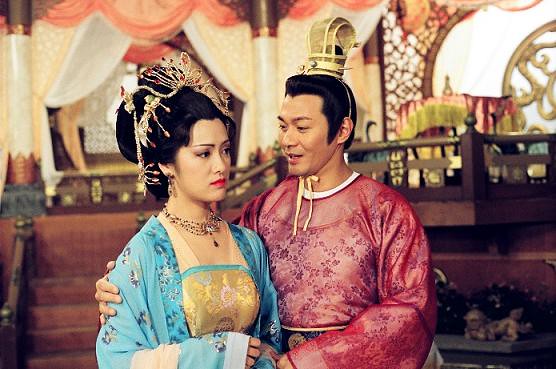
Xuanzong (Kwong Wah) and Yang Guifei (Anne Heung) in The Legend of Lady Yang
As the country flourished in prosperity, Xuanzong gradually grew tired of public life. He began indulging in the pleasures of court life. He particularly enjoyed spending time with his favourite concubine, Yang Guifei (楊貴妃). He left political matters to his advisers – among them, Yang Geifei's cousin, Yang Guozhong (楊國忠). The country was soon thrown into disarray due to Yang's mismanagement and corruption. The citizens faced high taxes and natural disasters, the military suffered blowing defeats, and the government became devoid of talent.

Meanwhile, An Lushan (安祿山) was a military general who had gained the favour of Xuanzong and Yang Guifei. He was given command over three large military contingents in the north, where he essentially operated as a warlord. However, he harboured higher aspirations. After many years of planning, An launched a rebellion near modern-day Beijing. Due to Xuanzong's earlier military reforms, most of the Tang army was stationed near the borders, leaving the country's interior lightly defended and allowing An's forces to easily make their way into the heartland. An captured Luoyang, the eastern capital, and declared himself emperor of a new Yan Dynasty. After a series of military missteps by Xuanzong, the path was clear for An to march to Chang'an, the western capital, where the emperor was located.

As An's forces approached, Xuanzong fled the capital with Yang Guifei. Along the way, the soldiers that were accompanying the emperor grew angry at the Yangs, whom they felt were responsible for the country's plight. The soldiers killed Yang Guozhong, then surrounded the emperor and demanded that he put Yang Guifei to death. In order to pacify his angry troops, Xuanzong reluctantly ordered his personal eunuch to strangle Yang Guifei.

After Yang Guifei's death, Xuanzong continued westward, while his son, the crown prince, stayed behind to plan a counterattack. On the advice of his officials and without consulting with Xuanzong, the crown prince took the throne and declared himself as Emperor Suzong (唐肅宗). When Xuanzong received this news, he affirmed the new emperor's proclamation and took the title of Retired Emperor. After Emperor Suzong recaptured Chang'an, Xuanzong moved back to the palace, where he lived until his death at the age of 76.

Saturday, June 14, 2014

Historical Profiles - China's Four Beauties


古語有云: 中國四大美人「沉魚落雁,閉月羞花」
According to legend, China's Four Beauties sunk the fishes, downed the birds, eclipsed the moon and shamed the flowers.


Xi Shi (Sonija Kwok) and Fan Li (Chen Kun) in The Conquest
Xi Shi (西施) was the beauty that sunk the fishes. Allegedly, whenever she looked into a pond, the fish will forget how to swim and sink to the bottom. Xi Shi lived during the Spring and Autumn period, at a time when her home state, Yue, was subordinate to the neighbouring State of Wu. In a bid to weaken the State of Wu, King Goujian of Yue (越王勾踐) asked his minister, Fan Li (范蠡), to present a group of beauties to King Fuchai of Wu (吳王夫差). Xi Shi was selected as part of the group and Fuchai instantly became so infatuated with her that he completely neglected his state affairs. Fuchai ordered palaces and parks to be built for her, eroding the wealth of the state. Eventually, Goujian was able to easily defeat the weak State of Wu and Fuchai was forced to commit suicide. After the fall of Wu, the common belief was that Xi Shi eloped with Fan Li to live a peaceful life on a fishing boat.


Wang Zhaojun (Rain Li) and Huhanye (Gallen Lo) in Lady Wang in Exile
Wang Zhaojun (王昭君) was the beauty that downed the birds. Legend has it that on her journey away from her hometown, she played sad tunes that caused the birds to look down. The birds were so dazed by her beauty that they forgot to flap their wings and fell to the ground. Wang Zhaojun was a candidate to be the concubine of Emperor Yuan during the Han Dynasty. However, because she had refused to bribe the imperial artist, the artist presented the Emperor with an ugly portrait of her and she was not selected as concubine. Later, Wang Zhaojun volunteered to marry the Xiongnu leader, Huhanye (呼韓邪), to secure friendly Han-Xiongnu relations. Before departing, she appeared before the Emperor who saw her true beauty for the first time. Although he could barely stand to part with her, he could not cancel the political marriage. With the marriage, the two nations were able to coexist peacefully for 60 years. In accordance to Xiongnu tradition, she married the next leader after her first husband’s death.


Diaochan (Chen Hao) and Lu Bu (Peter Ho) in Three Kingdoms
Diaochan (貂蟬) was the beauty that made the moon hide itself in shame. She was the adopted daughter of the Han Dynasty minister Wang Yun (王允), who used her in a plot to defeat the evil warlord Dong Zhuo (董卓). She was simultaneously offered to Dong Zhuo and his adopted son Lu Bu (呂布), causing rift between the two men. Seizing on the opportunity, Wang Yun convinced Lu Bu to murder Dong Zhuo. Diaochan’s fate afterwards is unknown, with accounts varying from her being killed by enemy forces to being released by Guan Yu and becoming a nun. There is actually little historical evidence to support the existence of Diaochan; most of the details about her were from Romance of the Three Kingdoms. However, historical records did mention that Lu Bu had an affair with Dong Zhuo’s maid.


Yang Guifei (Anne Heung) and Xuanzong (Kwong Wah) in The Legend of Lady Yang
Yang Guifei (楊貴妃) was the beauty that made the flowers shut. She was initially married to the son of Emperor Xuanzong (唐玄宗), however, her beauty caught the eye of the Emperor and he decided to take her for himself. The Emperor went to great extents to please her. For example, he ordered the fastest horses to run in relay style to deliver fresh lychee, her favourite fruit, from a thousand miles away. He also bestowed great honours on her family, including naming her cousin Yang Guozhong (楊國忠) as chancellor. The Emperor became uninterested in state affairs and as a result of Yang Guozhong’s manipulative tactics, the dynasty was soon sent into disarray by the An-Shi Rebellion. The Emperor fled the capital, along with Yang Guifei, and was later forced to put her to death in order to pacify his angry soldiers, who saw her as the reason for the dynasty’s decline.