Showing posts with label Historical Context. Show all posts

Tuesday, November 10, 2020

Historical Context: Mongol Empire

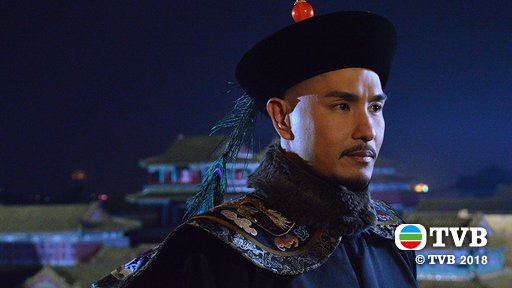
Genghis Khan family tree with characters from The Legend of Kublai Khan and Eternal Happiness

Genghis Khan (成吉思汗) established the Mongol Empire after uniting the tribes on the Mongol steepe. He was named the first Great Khan. He went on to conquer vast amounts of territory in Asia and Europe.

Genghis Khan had four sons with his wife, Börte (孛兒帖).

His eldest son was Jochi (朮赤). There were questions about Jochi’s true paternity because Börte had been held captive for eight months by a rival tribe sometime before his birth. Although Genghis Khan claimed Jochi as his son, he avoided naming him as his successor to avoid conflict with his other sons. When Jochi died, his son, Batu (拔都), inherited his territorial grants in the western part of the empire (modern-day southern Russia and Kazakhstan) and established the Golden Horde.

Genghis Khan’s second son was Chagatai (察合台). Chagatai was considered to be hot-tempered and vowed to oppose Jochi if Jochi was named as Genghis Khan’s successor. Chagatai ruled over the Chagatai Khanate, which covered territory in central Asia (modern-day Uzbekistan, Kyrgyzstan and Tajikistan).

Genghis Khan named his third son, Ögedei (窩闊台), as his successor. Under Ögedei, the Mongol Empire continued to expand across Asia and into central Europe. Ögedei personally led the Mongol conquest of the Jin Dynasty (which had ousted the Song Dynasty in northern China). This set the stage for the Mongols’ eventual conquest of China and establishment of the Yuan Dynasty. Ögedei reigned for twelve years. He was succeeded by his son, Güyük (貴由), after a five-year interregnum in which Ögedei’s widow, Töregene (脫列哥那), yielded power as regent. Güyük lasted less than two years as Great Khan and died while marching to challenge his cousin, Batu.

Genghis Khan’s youngest son was Tolui (拖雷). As the youngest son, he inherited the Mongol homeland in accordance to the Mongol tradition. After Genghis Khan’s death, Tolui served as regent of the empire for two years until his brother, Ögedei, could be formally elected as Great Khan. He then joined Ögedei in the campaign against the Jin Dynasty.  He died after successfully defeating the Jin. Although Tolui never ascended to the position of Great Khan, his descendants (the Toluids) would become dominant figures in the empire.

After the death of Güyük, Tolui’s eldest son, Möngke (蒙哥) was elected as Great Khan with the support of Batu. He faced opposition from members of the Ögedei and Chagatai families, but he quickly defeated them. During Möngke’s eight-year reign, he focused on conquering territory in southern Asia and the Middle East. He assigned his younger brother, Hulagu (旭烈兀), the task of conquering the Middle East. Hulagu was proclaimed the ruler of the Ilkhanate (which covered modern-day Iran, Turkey and Afghanistan) after his successful campaigns. 

The death on Möngke sparked civil war among the Toluids and across the empire. His younger brothers, Kublai (忽必烈) and Ariq Böke (阿里不哥) convened competing councils to elect them as Great Khan. Kublai finally defeated Ariq Böke after a four-year civil war. Kublai would go on to conquer the Song Dynasty and establish the Yuan Dynasty in China. He ruled as Emperor of China for 34 years. His original heir, Zhenjin (真金) had died, so he was succeeded by his grandson, Temür (鐵穆耳).


Friday, March 08, 2019

Historical Context - Lu Buwei

Kwok Fung played Lu Buwei in A Step into the Past.
Lu Buwei (呂不韋) was a politician during the Warring States period who served as chancellor of the Qin state for 13 years.

Lu was originally a merchant. He amassed a fortune selling goods all over the country. One time, while he was in the Zhao state, he met Yiren (嬴異人), a grandson of the Qin king. Yiren's father was the crown prince of Qin. But since Yiren was born to an unimportant concubine and was merely one of his father's many sons, he was sent to Zhao to serve as a hostage.

When Lu met Yiren, he compared Yiren to a rare piece of merchandise that could be stored for its value (leading to the Chinese saying "奇貨可居"). He decided to "invest" in Yiren. Yiren had been living in poor conditions in Zhao, so Lu gave him five hundred gold to upgrade his living conditions. He also presented Yiren with a beautiful lady from his household, Lady Zhao (趙姬). Lu spent another five hundred gold to buy gifts for Lady Huayang (華陽夫人), who was the principal consort of Yiren's father. Lu persuaded the childless Lady Huayang to adopt Yiren as her son, which made Yiren the presumptive heir to his father. As the hostilities between Qin and Zhao grew, Lu help Yiren escape from Zhao and return safely to Qin.

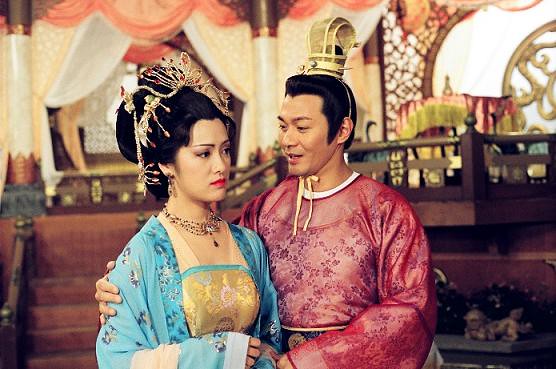
Yiren (Lee Lung Kei) and Lady Zhao (Eileen Yeow)
A few years later, the Qin king (Yiren's grandfather) died and Yiren's father succeeded to the throne. But his father died only three days into his reign and Yiren became the new ruler. He named Lu as his chancellor. That same year, Lu led a Qin army to crush a resistance by the remnants of the former Zhou dynasty.

Yiren died after three years on the throne and was succeeded by his thirteen year-old son, Ying Zheng (嬴政), the future Qin Shi Huang (秦始皇). Lu served as regent to the teenage king, who addressed him as "Uncle". Under Lu’s administration, the Qin state continued to expand its territory and weaken the forces of neighbouring states. Lu oversaw the construction of a large-scale canal project to improve irrigation, which provided agricultural resources to support Qin's growing army. He also recruited a lot of talent to Qin, including over 3000 scholars who stayed as guests in his household. He commissioned them to compile Lu's Spring and Autumn Annals (呂氏春秋), a comprehensive text that covered a wide range of subjects, from philosophy to military to agriculture. Famously, upon its completion, Lu displayed the text in public and offered a thousand gold pieces to anyone who could add or subtract a single word from it. No one claimed the prize.

Kwong Wah as Lao Ai
Meanwhile, Lu was having an affair with the Queen Dowager, Lady Zhao, the former lady from his household and now, mother of Ying Zheng. As Ying Zheng grew older, Lu worried that he would find out about the affair. To cover up the affair, he arranged for a well-endowed man, Lao Ai (嫪毐), to serve the Queen Dowager. Lao Ai posed as an eunuch so that he could come and go from the Queen Dowager’s bedroom without arousing suspicion. The Queen Dowager greatly favoured Lao Ai and even bore two illegitimate sons for him. When Ying Zheng discovered the Queen Dowager’s affairs, he was enraged. He ordered for Lao Ai to be executed and the illegitimate sons to be beaten to death.

Ying Zheng contemplated killing Lu as well, but ultimately decided to spare him because of Lu’s service to his father, Yiren. Lu was removed as chancellor and banished from the capital. About a year later, Ying Zheng suspected that Lu might be plotting against him and ordered Lu to move to a more remote region. Lu, fearing that he would eventually be executed, committed suicide instead.

Today, reactions to Lu are mixed. He is typically portrayed in media works as a power-hungry politician who dominated the court and oppressed his opponents. This is not untrue. But at the same time, he was a shrewd tactician who engineered the succession of Yiren to the throne. His military strategy and domestic policies while serving as chancellor helped solidify Qin’s power and enabled Ying Zheng to eventually conquer the other states.


Thursday, August 16, 2018

Story of Yanxi Palace Connection

I am not watching Story of Yanxi Palace, but found that it had some interesting connections to Succession War.

Story of Yanxi Palace takes place during the Qianlong era, which directly precedes the time period of Succession War.

The Emperor in Story of Yanxi Palace is the Qianlong Emperor (乾隆帝). He is the younger version of KK Cheung's character from Succession War.

The initial Empress in the series is Qianlong's first Empress. She was a virtuous queen whom Qianlong loved dearly. Unfortunately, she died of illness during the thirteenth year of his reign.
  • The brother of the Empress is Feheng (傅恆). He is the father of Fuk'anggan (福康安) (Kenneth Fok in Succession War) and Fu Changan (福長安) (Joel Chan in Succession War).

After the first Empress died, Charmaine Sheh's character becomes the second Empress. However, she later abruptly falls out of favour with the emperor for unknown reasons.

The main actress in Story of Yanxi Palace will become Qianlong's concubine, reaching the rank of Imperial Noble Consort (皇貴妃). When the second Empress died, Qianlong did not name another empress and she served as the de facto empress.
  • She is the mother of the Jiaqing Emperor (嘉慶帝) (Shaun Tam in Succession War) and was posthumously honoured as Empress when he was named crown prince.
  • She is also the mother of Qianlong's 17th son (Jonathan Cheung in Succession War) and 7th daughter. The 7th princess was married to Mongol nobleman, Lavan Dorji (拉旺多爾濟) (Andrew Yuen in Succession War).

The younger version of Angelina Lo's character in Succession War appears in Story of Yanxi Palace as Noble Lady Ying (穎貴人).


Saturday, July 28, 2018

Historical Context: Heshen


Heshen (和珅) was a prominent Qing official during the Qianlong era. He is known as the most corrupt official in Chinese history, accumulating a personal wealth that was equivalent to 15 years of the government's revenue.

Heshen was born to a Manchu military official. Both his parents died when he was young, leaving him and his brother, Helin (和琳), to be raised by their family's housekeeper, Liu Quan (劉全). Heshen attended a school for Manchu aristocrats, where he was an impressive student. By the age of 18, he was fluent in four languages and well-versed in the classical texts.

At the age of 22, Heshen entered the palace to serve as a palace guard. Shortly afterwards, he caught the attention of the Qianlong Emperor, and thereafter, began a meteoric rise through the ranks. Within a few years, he held high-ranking positions in all of the key departments, including the Imperial Household Departments, Ministry of Revenue, and Grand Council. He further secured power by marrying his son, Fengshen Yinde (豐紳殷德), to the Qianlong Emperor's youngest princess.

Initially, Heshen was an honest official who rejected gifts from people who wanted to bribe him. This was until he got his first taste of wealth when he was put in charge of investigating the corrupt official, Li Shiyao (李侍堯). After Li was arrested, Heshen secretly kept much of the confiscated assets for himself.

Henry Lo plays Heshen in Word Twisters' Adventure.
After the Li Shiyao case, Heshen's greed and ambitions grew. He began to accept bribes and form his own clique. Because he held so many high-ranking positions, he was able to eliminate his political opponents and insert his cronies into key positions. His corrupt network expanded throughout the bureaucracy and across the nation. They routinely siphoned money from public funds, including military and emergency relief funds. Heshen demanded bribes from government officials and turned the imperial examination system into an auction for government jobs. He also established a system where officials who were found guilty of corruption could buy their way out of punishment. It caused systematic, widespread corruption at all levels of government that lasted well past Heshen's time in power and contributed to the Qing Dynasty's decline.

Heshen lived a luxurious lifestyle. He had hundreds of women and servants living in his home. His mansion was comparable to the imperial palace, constructed using materials stolen from the palace and replicating its designs. He frequently hosted banquets and dined on delicacies with golden utensils. He owned a large amount of furniture, vases, art pieces, silk, clothing, animal hide, and other valuable possessions.


The Qianlong Emperor was well-aware of Heshen's corruption, but never sought to punish him. The emperor acquiesced to Heshen’s corrupt conduct because Heshen filled the palace’s coffers to pay for Qianlong’s extravagant spending and southern expeditions. Heshen was also good at flattery, attentive and knew how to cater to the elderly emperor’s tastes. For example, he spent time studying Qianlong’s poetic style and frequently discussed poetry with the emperor. Qianlong was very fond of Heshen’s literary talents.

A Connection With Nancy Wu?


As the Qianlong Emperor grew older, he often was not able to speak clearly and only Heshen could understand what he was saying. Thus, whenever he held court, he would order Heshen to stand next to him. Heshen would "listen" to what the emperor said and then issue edicts on his behalf. This earned Heshen the nickname as the "Second Emperor".


Upon Qianlong's death, the Jiaqing Emperor quickly stripped Heshen of his official titles and ordered for him to be arrested. He was declared guilty of 20 great sins and was sentenced to death by slow slicing. However, his daughter-in-law, the Tenth Princess, pleaded with Jiaqing to allow him to commit suicide. Jiaqing granted the request and Heshen hung himself at his home. His family was spared on account of their relationship with the Tenth Princess.

After his death, it was discovered that Heshen's personal wealth was worth between 800 to 1100 million taels of silver (compared to the government's annual revenue of only 70 million taels of silver). His net worth is estimated to be about $132 billion USD in today's dollars, putting him among the richest individuals in history.

Heshen's former mansion was granted to Jiaqing's 17th brother, Yonglin (Jonathan Cheung in Succession War), while the gardens were given to his 11th brother, Yongsing (David Do in Succession War). Later, the residence was given the Daoguang Emperor's sixth son, Prince Gong (KK Cheung in The Confidant). The mansion is now a museum in Beijing.


Wednesday, July 18, 2018

Historical Context: Li Chengqi


Li Chengqi (李成器) was the eldest son of Emperor Ruizong. At the age of six, he was named crown prince when his father became emperor, but he was demoted from that position when his grandmother, Wu Zetian, became emperor.

Later, his brother, the future Emperor Xuanzong, staged a successful coup and restored their father, Ruizong, to the throne. As the eldest son, Li Chengqi was expected to be renamed as crown prince. However, he voluntarily yielded the position to Xuanzong. Initially, Ruizong was hesitant about this decision because under Confucian principles, the eldest son was the proper heir to the throne. However, Li pleaded with Ruizong, saying "During times of peace, the eldest son should come first, but during times of difficulties, those with merit should be chosen." Ruizong finally relented and named Xuanzong as crown prince. Li accepted a position as adviser to Xuanzong.

Li had a close relationship with Xuanzong, despite constant rumours that he could threaten Xuanzong's claim to the throne. For his part, Li remained humble and stayed out of political matters. Instead, he enjoyed studying music and the arts. He was known for his proficiency with music from different cultures and was particularly skilled at playing the flute and drums. As emperor, Xuanzong treated Li and their other brothers very well. He built mansions for them near the palace and often invited them to enjoy food, drinks and music together. As the years went on, their other brothers passed away one by one, and Li was Xuanzong's only surviving brother. Thus, Xuanzong valued him even more. He often sent gifts and food to Li and personally visited him on his birthdays.

Li died at the age of 63. Xuanzong greatly mourned him and posthumously named him as Emperor Rang (讓皇帝), meaning the "emperor who yielded", in recognition of his status as the proper heir.

Watch this clip from Deep in the Realm of Conscience which shows Li Chengqi's affinity for the arts and the yielding of the crown prince position to his brother. 

Tuesday, June 26, 2018

Succession War Connection

Let’s situate Succession War in the TVB Qing Dynasty world.

As you will recall, Ben Wong played the Yongzheng Emperor in Gilded Chopsticks.

He is the father of the Qianlong Emperor, played by KK Cheung in Succession War. Qianlong retires as emperor after 60 years, passing the throne to his son, the Jiaqing Emperor.

Shaun Tam plays the Jiaqing Emperor in Succession War. It is the same character as Yu Yang in War and Beauty.

Jiaqing’s first Empress is Jess Sum. She is the mother of his eventual successor, the Daoguang Emperor, played by child actor Nono Yeung. He will grow up to be Sunny Chan in Curse of the Royal Harem.

The first Empress (Jess) has already died at the time of Succession War. Selena Li is Jiaqing's Imperial Noble Consort and will eventually become his second Empress. The character becomes Rebecca Chan in War and Beauty and is made Empress Dowager in Curse of the Royal Harem, played by Gigi Wong.

Looking at Jiaqing’s other concubines, Katherine Ho plays Concubine Yu, who will later be promoted to be Consort Yu, a character famously played by Sheren Tang in War and Beauty. Siu Hoi Yan plays Consort Hua, who is Gigi Lai in War and Beauty.

Also, notice how the imperial crown and robes has been "passed down" through the generations.


See Gilded Chopsticks Connection for map before this era
                          ↓
                          ↓


Related: Beauty At War Connection (map of the same era)

Friday, June 08, 2018

The Revenge of Savio Tsang


Spoiler ahead!

Wu Youji (武攸暨) was a nephew of Wu Zetian and second husband of Princess Taiping. His marriage to the princess came about after her first husband was put to death for treason. Wu Zetian decided to marry Princess Taiping to Wu Youji to strengthen the ties between the Wu clan and the imperial Li clan. However, he was already married at that time, so Wu Zetian had his wife secretly killed to allow the marriage to proceed.

Wu Youji was a kind and unambitious man who largely stayed out of politics. He and Princess Taiping had two sons and a daughter. He died of illness shortly before the end of Emperor Ruizong's second reign.

In Deep in the Realm of Conscience, Wu Youji (Savio Tsang) is executed after he took the blame for Princess Taiping (Alice Chan) when it was revealed that she had been torturing a maid for twenty years. The secret came to light because of investigation by the future Emperor Xuanzong (Steven Ma). Thus, after his death, Wu Youji reincarnates to become...

Yang Guozhong (楊國忠) in The Legend of Lady Yang!


Yang Guozhong is the cousin of Emperor Xuanzong's favourite concubine, Yang Guifei. He is often blamed for the decline of the Tang Dynasty during the later part of Xuanzong's reign. Relying on his connection with Yang Guifei, Yang secured a position on the court and eventually became chancellor. He was corrupt and extremely incompetent in managing the affairs of the country. As a result, the country experienced a sharp decline from its height. Moreover, Yang's rivalry with military general An Lushan prompted An to launch a rebellion. His ill-advised military strategy further enabled An to capture the capital. Yang was killed by Xuanzong's soldiers when he was fleeing from the city.


Thursday, June 07, 2018

Historical Context: Emperor Xuanzong

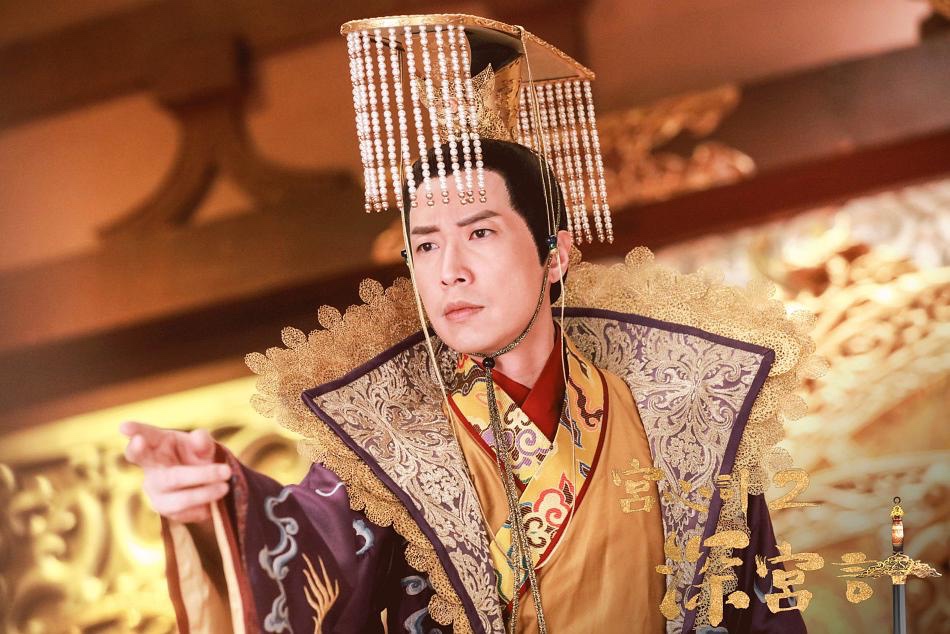
深宮計

Emperor Xuanzong of Tang (唐玄宗) was the ninth emperor of the Tang Dynasty. He presided over one of the golden ages of the Tang Dynasty during his first three decades on the throne, but also saw the beginning of the dynasty’s decline in his later years. His reign of 43 years is the longest of any Tang emperor.

Xuanzong was the third son of Emperor Ruizong (唐睿宗). Although Ruizong was nominally the emperor, the real power resided with the empress dowager Wu Zetian (武則天). When Xuanzong was five, his father abdicated in favour of Wu Zetian, who officially became female Emperor. Growing up, Xuanzong was reportedly a talented and courageous young man and was adored by his grandmother.

When Xuanzong was twenty, Wu Zetian was overthrown in a coup and Xuanzong’s uncle, Emperor Zhongzong (唐中宗) retook the throne. However, power was concentrated in the hands of his wife, Empress Wei (韋皇后). When Zhongzong died, his 16-year old son ascended to the throne as Emperor Shang (唐殤帝), with Empress Wei acting as regent. Fearing that Empress Wei would usurp the throne like Wu Zetian, Xuanzong and his aunt, Princess Taiping (太平公主), launched a coup. They killed Empress Wei and executed many of her allies. They forced Emperor Shang to step down just 17 days into his reign and convinced Xuanzong’s father, Ruizong, to reclaim the throne. For his efforts in the successful coup, Xuanzong was named as crown prince.

During his time as crown prince, Xuanzong's relationship with his aunt, Princess Taiping, became increasingly hostile. Princess Taiping had initially supported him to be crown prince because she thought he could be easily manipulable, but when she discovered that this was not the case, she tried to have him removed as crown prince. However, much to her chagrin, Ruizong decided the best way to resolve the hostilities was to abdicate and pass the throne to Xuanzong.


As emperor, one of Xuanzong's first priorities was to remove Princess Taiping from power. He got his chance when he received a report that she was plotting to overthrow him. He personally led soliders to arrest and execute her associates. Hearing of this, Princess Taiping fled to a temple and hid for three days. When she finally emerged, Xuanzong ordered her to commit suicide.

After ridding the court of Princess Taiping's influence, Xuanzong was finally able to rule on his own. He proved to be a capable ruler, leading the country into a golden age of prosperity. Politically, he brought stability to the court after decades of infighting and coups within the palace. He promoted competent officials to be his advisers and purged the government of officials who gained their positions through money or connections. Economically, Xuanzong re-established trade routes on the Silk Road and Grand Canal and ordered for a nationwide census to be conducted to update the tax rolls and improve land distribution. These measures vastly increased the nation's tax revenues and grain reserves. Militarily, he abolished the conscription of farmers. Instead, he recruited career soldiers for the army. He reorganized the border forces to centralize control under military governors and improve border defense. Culturally, he commissioned officials to search for literature from all eras, compiling a library with more than 50,000 works. A talented poet, calligrapher and musician himself, Xuanzong created academies to promote the arts. Two of most famous Tang Dynasty poets, Li Bai (李白) and Du Fu (杜甫), lived during this period.

Xuanzong (Kwong Wah) and Yang Guifei (Anne Heung) in The Legend of Lady Yang
As the country flourished in prosperity, Xuanzong gradually grew tired of public life. He began indulging in the pleasures of court life. He particularly enjoyed spending time with his favourite concubine, Yang Guifei (楊貴妃). He left political matters to his advisers – among them, Yang Geifei's cousin, Yang Guozhong (楊國忠). The country was soon thrown into disarray due to Yang's mismanagement and corruption. The citizens faced high taxes and natural disasters, the military suffered blowing defeats, and the government became devoid of talent.

Meanwhile, An Lushan (安祿山) was a military general who had gained the favour of Xuanzong and Yang Guifei. He was given command over three large military contingents in the north, where he essentially operated as a warlord. However, he harboured higher aspirations. After many years of planning, An launched a rebellion near modern-day Beijing. Due to Xuanzong's earlier military reforms, most of the Tang army was stationed near the borders, leaving the country's interior lightly defended and allowing An's forces to easily make their way into the heartland. An captured Luoyang, the eastern capital, and declared himself emperor of a new Yan Dynasty. After a series of military missteps by Xuanzong, the path was clear for An to march to Chang'an, the western capital, where the emperor was located.

As An's forces approached, Xuanzong fled the capital with Yang Guifei. Along the way, the soldiers that were accompanying the emperor grew angry at the Yangs, whom they felt were responsible for the country's plight. The soldiers killed Yang Guozhong, then surrounded the emperor and demanded that he put Yang Guifei to death. In order to pacify his angry troops, Xuanzong reluctantly ordered his personal eunuch to strangle Yang Guifei.

After Yang Guifei's death, Xuanzong continued westward, while his son, the crown prince, stayed behind to plan a counterattack. On the advice of his officials and without consulting with Xuanzong, the crown prince took the throne and declared himself as Emperor Suzong (唐肅宗). When Xuanzong received this news, he affirmed the new emperor's proclamation and took the title of Retired Emperor. After Emperor Suzong recaptured Chang'an, Xuanzong moved back to the palace, where he lived until his death at the age of 76.

Sunday, May 20, 2018

Deep in the Realm of Conscience Connection

Wu Zetian (Rebecca Chan in The Greatness of a Hero) is the mother of Emperor Zhongzong (Raymond Cho in The Greatness of a Hero), Emperor Ruizong (Lee Lung Kei in Deep in the Realm of Conscience) and Princess Taiping (Alice Chan in Deep in the Realm of Conscience). Her husband is the Emperor Gaozong.
  1. When Emperor Gaozong dies, he is succeeded by his son, Emperor Zhongzong (Raymond Cho). Empress Wei (Michelle Yim in Deep in the Realm of Conscience) is Zhongzong's wife. 
  2. Less than two months into his reign, Zhongzong is removed from the throne by his mother, Wu Zetian. She replaces him with his brother, Emperor Ruizong (Lee Lung Kei). 
  3. Eventually, Ruizong abdicates in favour of his mother. Wu Zetian establishes the Zhou Dynasty and rules as female Emperor for the next fifteen years. The events of The Greatness of a Hero take place during this period. 
  4. Wu Zetian is deposed in a palace coup. Zhongzong (Raymond Cho) is restored to the throne and the Tang Dynasty is resumed. 
  5. Zhongzong dies under mysterious circumstances (suspected poisoning by Empress Wei) and is succeeded by his son, Emperor Shang.
  6. Emperor Shang's reign lasts only 17 days as he is deposed in a coup led by the future Emperor Xuanzong (Steven Ma in Deep in the Realm of Conscience) and Princess Taiping (Alice Chan). They execute Empress Wei (Michelle Yim) and persuade Emperor Ruizong (Lee Lung Kei) to reclaim the throne. The events of Deep in the Realm of Conscience begin around this time. 
  7. Ruizong retires as emperor and passes the throne to his son, Emperor Xuanzong (Steven Ma). Empress Wang (Nancy Wu in Deep in the Realm of Conscience) is Xuanzong's wife. In his later years, Xuanzong (now Kwong Wah in The Legend of Lady Yang) falls in love with Yang Guifei (Anne Heung in The Legend of Lady Yang).
Emperor Xuanzong II (Moses Chan in Beyond the Realm of Conscience) is a sixth generation descendant of Emperor Xuanzong (Steven Ma/Kwong Wah). He eventually succeeds to the throne as the 19th emperor of the Tang Dynasty.
Note: Emperor Xuanzong (玄宗) and Xuanzong II (宣宗) have distinct Chinese characters in their names, but their names are spelled the same when romanized, thus the latter is sometimes referred to as 'Xuanzong II' in western sources.

yellow arrows = prior to the Zhou Dynasty
blue arrows = after the Zhou Dynasty


Friday, September 15, 2017

A Eunuch - Wei Zhongxian


Wei Zhongxian (魏忠賢) was a powerful eunuch during the late-Ming Dynasty. He led the eunuch faction that dominated the Ming court during the reign of the Tianqi Emperor.

Wei was born to a poor family. In his youth, he enjoyed drinking, being with prostitutes and gambling. He was illiterate, but a talented archer and horseman. He had a wife and daughter, but at age 21, he decided to castrate himself and enter the palace in order to escape from his gambling debts. Wei made friends with powerful people in the palace and eventually landed a job serving the household of the future Tianqi Emperor (known by his temple name 明熹宗). With his skill for flattery, Wei gained the favour of the future emperor. He also courted Madame Ke (客氏), who was Tianqi’s wet nurse. Tianqi revered Madame Ko and bestowed high honours on her when he became emperor. Madame Ke would become Wei’s lover and a key political ally.

The Tianqi Emperor ascended to the throne at the age of 15. He took little interest in political affairs and pursued his passion for carpentry instead. Wei seized on this opportunity. He often intentionally interrupted the emperor while he was enjoying himself to report on political matters. The emperor would respond by saying, “I am busy. You take care of it.” Eventually, Wei issued edicts without even consulting the emperor. He promoted his allies into high positions and terrorized anyone who dared to oppose him. Officials everywhere scrambled to send memorials praising Wei and build temples in his honour. People even greeted him as “Nine Thousand Years”, just a degree below the emperor, who was greeted with “Ten Thousand Years”.

The Donglin scholars on the court despised the power that Wei wielded and submitted a memorial to the emperor criticizing Wei, but the emperor ignored it. The incident turned Wei against the Donglin faction. He fabricated charges against a group of six scholars, including Zuo Guangdou, and had them tortured to death in prison. Later, he purged a second group of seven scholars. The influence of the Donglin faction was substantially weakened after these incidents.

The Tianqi Emperor died of illness and was succeeded by his brother, the Chongzhen Emperor (崇禎). Chongzhen moved quickly to get rid of Wei. He asked officials to submit a list of Wei’s crimes and sentenced Wei to exile. As Wei travelled to his place of exile, Chongzhen heard rumours that Wei would attempt a rebellion. He ordered Wei to be arrested and brought back to the capital. Knowing that he would not escape a death sentence, Wei committed suicide. His corpse was posthumously subjected to slow slicing and publicly displayed. After Wei's death, the Chongzhen Emperor purged the remaining members of the eunuch faction from the Ming court.

Despite the overwhelmingly negative portrayal of Wei, some historians give him credit for effectively managing the country. Compared to the Chongzhen era, the Tianqi years were relatively peaceful, with stability on the war front and no major uprisings. It can partly be attributed to Wei's recommendations of able generals, such as Yuan Chonghuan, and setting low tax rates for farmers.


Related:
A General - Yuan Chonghuan
A Scholar - Zuo Guangdou

Saturday, September 02, 2017

A Scholar - Zuo Guangdou


Zuo Guangdou (左光斗) was a late-Ming Dynasty scholar. He was a leader of the Donglin faction during the reign of the Tianqi Emperor and was one of six Donglin scholars who was tortured to death by the eunuch Wei Zhongxian.

Growing up, Zuo loved to read books. He especially liked to learn about practical issues that affected the people’s daily lives. He had aspirations to serve his country and the people. During the Wanli (萬曆) era, Zuo was appointed as an official in Beijing. He immediately worked on fighting corruption and arresting imposters who posed as government officials to defraud and intimidate people. He also revitalized the agricultural industry in the north by improving the hydraulic systems and building dams to divert water resources to the region.

Bob Cheung's Crown Prince role is the future Taichang Emperor.
After the Wanli Emperor, the Taichang Emperor (known by his temple name 明光宗) died one month into his reign and was succeeded by his teenage son, the Tianqi Emperor (temple name 明熹宗). In the immediate aftermath of the Taichang Emperor's death, Zuo was involved in the “Palace Removal Case” (移宮案). When the Taichang Emperor took the throne, he had moved into the emperor’s official residence with his favourite concubine, Attendant “West Li” (西李選侍). When he died, Li remained at the residence with the newly-crowned Tianqi Emperor, whom she had raised, and tried to get herself named as empress dowager. Fearing that she would hold the young emperor hostage, court officials rushed to the palace and took him away. They then pressured her to move out of the residence, but she refused. Finally, Zuo persuaded the emperor to issue an edict ordering her to move out by reminding him of how Wu Zetian seized power.

As a result of the Palace Removal Case, Zuo and the Donglin officials that were involved gained prominence. They were noble and loyal officials who were unafraid to speak out. But at the same time, eunuch Wei Zhongxian (魏忠賢) rose to power and the conflict between the eunuch and Donglin factions grew more intense. Unable to tolerate Wei’s abuse of power, Zuo and his colleagues submitted a memorial to the emperor, outlining Wei’s various crimes, but it was ignored by the emperor. Seeking revenge, Wei falsely accused six Donglin officials, including Zuo, of accepting bribes. The six were arrested and tortured to death in prison. Their names would later be cleared of wrongdoing by the Chongzhen Emperor.


Related:
A General - Yuan Chonghuan
A Eunuch - Wei Zhongxian

Wednesday, August 30, 2017

A General - Yuan Chonghuan


Yuan Chonghuan (袁崇煥) was a military general during the late-Ming Dynasty. He is best known for defending the Ming borders against Jurchen invasion.

As a young man, Yuan had a strong interest in military affairs. He travelled the country and frequently chatted with retired soldiers. Yuan started his career as a magistrate, but soon moved to the Ministry of War. At that time, the Ming borders were constantly being threatened by the Jurchens. On one occasion, Yuan travelled alone to the front lines to survey the situation. When he returned to the capital, he asserted that he could defend the borders if he was given the necessary resources. He was assigned to the frontier and given funds to recruit troops.

At the frontier, Yuan gained the trust of his superior and persuaded him to build a defensive line consisting of posts beyond the Great Wall. Yuan was tasked with fortifying the city of Ningyuan (寧遠). However, when a new commander took over, he changed strategies and ordered all troops to retreat to the Great Wall. Yuan refused the order and was left to defend Ningyuan with only 10,000 men. Jurchen chief Nurhaci (努爾哈赤) got news of the retreat and led an army of 130,000 soldiers to attack Ningyuan. The Jurchens laid siege on the city, but the Ming defenders fended them off with cannon fire. Yuan had reportedly spent much time studying the cannons to ensure it would fire accurately. Nurhaci suffered injuries from a cannon shot and would later die of his wounds. The Battle of Ningyuan was Nurhaci’s first and only major military loss to the Ming.

Following Yuan’s victory, he was put in charge of the forces at the frontier. As the Jurchens shifted their focus on attacking Korea, Yuan took the opportunity to rebuild the defensive line that he had envisioned. The defensive line stretched approximately 200 km, starting with the Shanhai Pass (山海關) at the Great Wall, extending to Ningyuan, and ending at Jinzhou (錦州). When Nurhaci’s successor, Hong Taiji (皇太極), led an army to invade the Ming border, he was repealed by the defense forces in Jinzhou and Ningyuan, proving the effectiveness of Yuan’s strategy.

Moses Chan as the Chongzhen Emperor in Perish in the Name of Love
Despite scoring a second major victory against the Jurchens, Yuan was forced into retirement by the eunuch faction, who sent criticisms of Yuan to the emperor. However, Yuan was recalled the next year by the newly-enthroned Chongzhen Emperor (崇禎帝). He was given full authority for military affairs on the frontier. Using this authority, he executed a Ming general named Mao Wenlong (毛文龍) on charges of corruption. Mao was a general that was stationed in the Korean Peninsula. His position kept the Jurchens in check because if they attempted a massive invasion of the China proper, they risked an attack by Mao on the eastern front. But Yuan likely despised Mao’s arrogant behaviour and spending, or perhaps felt threatened by him. Mao’s execution caused the Chongzhen Emperor to be dissatisfied with Yuan.

The elimination of Mao provided the Jurchens with a prime opportunity to attack. This time, instead of attacking in the northeast region where Yuan was stationed, Hong Taiji travelled through Mongolia and attacked in the west. It marked the first time the Jurchens were able to breach the Great Wall. They reached the walls of Beijing before Yuan arrived with reinforcements to drive them away. Subsequently, Hong Taiji spread rumours that he had colluded with Yuan. Already unhappy with Yuan over the execution of Mao, the Chongzhen Emperor ordered for his arrest and sentenced him to death by slow slicing.

After the death of Yuan, the Ming army was no longer able to contain the Jurchens. The Jurchens breached the Great Wall several more times, causing countless deaths and plundering the region. The Ming Dynasty was thrown into disarray and would soon fall at the hands of rebels.

Yuan was posthumously cleared of treason during the Qing Dynasty.

Credits to Wikipedia user Evawen (English labels added)


Related:
A Scholar - Zuo Guangdou
A Eunuch - Wei Zhongxian

Friday, November 27, 2015

Marco Polo Bridge Incident


The July 7 Incident, also known as the Marco Polo Bridge Incident, marks the start of the Second Sino-Japanese War.

The Marco Polo Bridge is an eleven-arch granite bridge located near Beijing. It was an important strategic location because it was the only link between Beijing and southern regions of China. On the eastern end of the bridge is a walled town, Wanping.

The Boxer Protocol of 1901 permitted foreign nations to station guards along the railroads near Beijing. As a result, the Japanese had between 7000-15,000 troops stationed in the area in 1937.

On July 7, 1937, the Japanese army was conducting nighttime military exercises in the area. They reported that one of their soldiers were missing and requested to enter Wanping to conduct a search. The Chinese denied permission. Shots were fired (it is still not entirely clear who fired the shots).

Later, Japanese infantry tried to forcefully enter Wanping. The Chinese repelled their attacks. Both sides called for reinforcements. In the wee hours on July 8, the Japanese overtook the bridge with tanks and infantry. The Chinese tried to defend the bridge with just 100 men. On July 9, Chinese reinforcements arrived and drove the Japanese off the bridge. The two sides negotiated a ceasefire. They reached an agreement on July 11, in which the Chinese agreed to apologize for the incident and the Japanese agreed to withdraw its troops from the immediate area.

Although the ceasefire was in place, the tensions between the two sides continued to escalate. Both sides sent additional troops into the area. On July 20, the Japanese shelled Wanping. By July 27, the Chinese troops were forced to retreat. The Japanese were able to move in to surround Beijing and Tianjian. Full-scale war broke out on August 9 with the Battle of Shanghai.

This incident was mentioned in the synopsis for Lord of Shanghai, but I'm not sure which episode it actually appears in the drama.


Sunday, May 03, 2015

Historical Profiles: Wu Zetian

Rebecca Chan played Wu Zetian in The Greatness of a Hero.

Wu Zetian (武則天) was the only female emperor to rule China, reigning for 15 years in her self-proclaimed Zhou Dynasty, which interrupted the Tang Dynasty. She is widely known for her ruthless tactics to attain power, but she also proved to be an effective ruler once in power.

Wu was born into a wealthy family and had the opportunity to learn to read and write in her youth. She was well-educated on a variety of topics, including politics, history and literature. At the age of 14, she entered the palace to be a concubine of Emperor Taizong of Tang (唐太宗). Although she apparently had sexual relations with him at some point, she never bore him any children. According to custom, childless concubines had to become nuns upon the emperor's death. Thus, when Emperor Taizong died, Wu was sent to a nunnery.

However, while Wu was still Taizong's concubine, she was having an affair with his son, Li Zhi (李治), who would go on to succeed his father as Emperor Gaozong of Tang (唐高宗). After Wu moved to the nunnery, Gaozong visited her and decided to bring her back as his own concubine. At that time, Empress Wang (wife of Gaozong) supported this because she wanted Wu to divert the emperor's attention away from another one of his favourite concubines.

Wu returned to the palace and soon gave birth to two sons. She also gave birth to a daughter, who died shortly after birth. Wu accused Empress Wang of killing the baby and further accused the empress of using witchcraft. Empress Wang was eventually deposed and Wu was created empress in her place. Popular theory suggest that Wu had deliberately killed her own child in order to frame the empress. Sometime later, she gave birth to two more sons.

Now as Empress Wu, she began to accumulate political power. Since Gaozong often suffered from illness (some believe it was due to slow poisoning by her), she increasingly took control of state affairs. She used the opportunity to get rid of officials that opposed her. She also convinced Gaozong to make her son the crown prince, but then successively deposed two of her sons as crown prince when she became displeased with them.

Raymond Cho as Li Xian (Emperor Zhongzong)

When Gaozong died, Wu's third son, Li Xian (李顯), took the throne as Emperor Zhongzong (唐中宗). However, she felt he was too difficult to control and removed him from the throne after just six weeks. He was exiled and his brother, Li Dan (李旦), was put in place as Emperor Ruizong (唐睿宗). But by now, it was clear that Wu held all of the power and Ruizong was nothing more than a puppet ruler. Finally, in 690, six years into his reign, Ruizong abdicated in favour of his mother and Wu Zetian officially became Emperor. At age 67, she was the oldest Chinese monarch to assume the throne. She proclaimed a new dynasty, the Zhou Dynasty, to replace the Tang Dynasty.

Wu ruled with a reign of terror, employing a secret police force and informants to spy on her opponents. She ruthlessly eliminated anyone that she perceived to be a threat, including many from her own family and the Li imperial family. Nonetheless, Wu proved to be an effective ruler. She selected officials based on their merits rather than their background and reformed the imperial examination system to give talented but poor scholars a fair shot at succeeding. For peasant farmers, she ensured fair distribution of land, developed new irrigation practices and ordered farming books to be written. Socially, Wu sought to improve the status of women by compiling biographies of notable women in history and making the mourning period for the death of one's mother equal to that of a father. Wu also pacified the wars in the northwest region and oversaw the empire at the height of its territorial extent up until that point in time. Overall, people enjoyed stable lives and the economy developed steadily.

Wayne Lai and Eric Li played as Wu Zetian's nephews.

Throughout her reign, Wu faced the constant question of succession. Initially, when she took the throne, she named Li Dan (the former Emperor Ruizong) as crown prince. However, some officials tried to persuade her to name one of her nephews as her successor. They argued that the throne has always been passed to someone with the same surname as the last emperor. But ultimately, she rejected this idea when other officials argued that a son was closer in relations than a nephew. She later recalled Li Xian (the former Emperor Zhongzong) from exile to replace Li Dan as the crown prince.

In her later years, Wu became seriously ill. Several officials, with agreement from the crown prince Li Xian, stormed into her palace and forced her to abdicate. Li Xian was restored to the throne as Emperor Zhongzong once again and the Tang Dynasty was resumed. Months later, Wu Zetian died and was buried alongside her husband Emperor Gaozong. Her tomb is marked by a large stele that was not inscribed with any words, known as the "Wordless Stele" (無字碑).

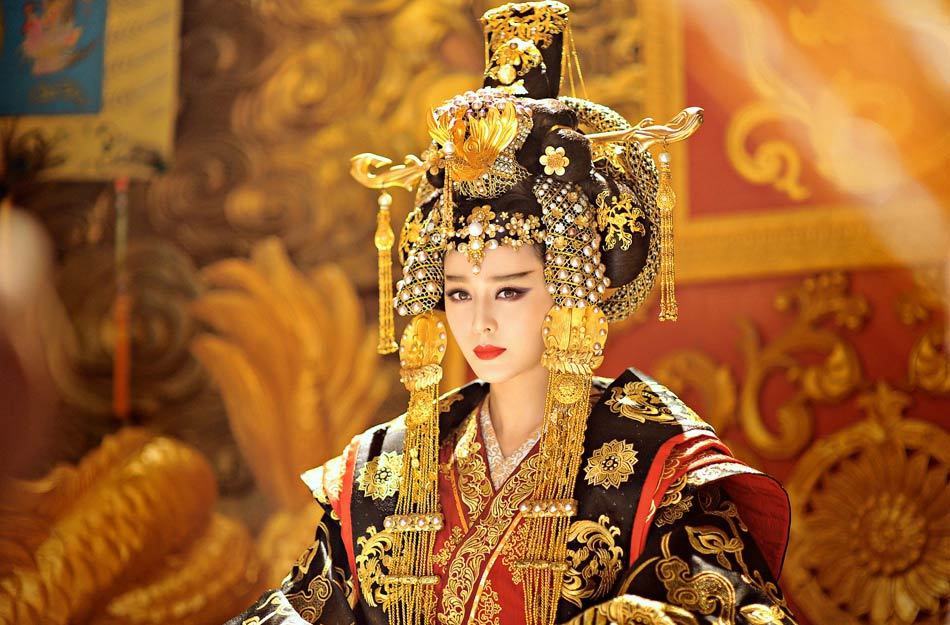
Fan Bingbing stars as Wu Zetian in The Empress of China.

Saturday, March 28, 2015

Forbidden City Exhibition

Since it is #MuseumWeek on Twitter, it is a perfect time to write this post that I've been meaning to do for a long time. Last summer, I visited the Royal Ontario Museum (ROM) to see The Forbidden City exhibition. It featured a vast collection of artifacts from the Forbidden City, home to the emperors of the Ming and Qing Dynasty. Here were some of the interesting things:

Clothing

This is the ceremonial robe worn by the young Tongzhi Emperor at his coronation. Compare it with the robes worn by Oscar Leung and Pako Au, who both played Tongzhi in The Confidant.
 

There were different attire for different occasions. On the left is a ceremonial robe worn by the Jiaqing Emperor for the sacrifice ceremony at the autumn equinox. On the right is a ceremonial armour for the Yongzheng Emperor when he performed military inspections.
 

Here are some styles for imperial women. The left picture shows an Empress's ceremonial summer coat and the right picture shows an informal riding jacket.
 

This dress was most likely worn by Empress Dowager Cixi, as it is similar to the dress that she was wearing in the portrait on the right.
 portrait_of_empress_dowager_cixi.jpg

Even animals got special treatment! On the left is a saddle made for the emperor's horse. On the right is an outfit made for an imperial dog. There were special eunuchs assigned to take care of the royal animals.
 

Footwear for men versus women in the palace.


Symbols of Authority

This was the setting of the imperial throne in the Inner Court. It was less lavish than the throne in the formal halls of the Outer Court, but still conveyed the Emperor's royal status. It was surrounded by various objects such as fans with elephant stands, crane candle-holders and luduan (a Chinese mythical creature) figures. Compare it to TVB's setting in The Confidant.
Posted Image

Each emperor inherits the set of imperial seals. Originally, there were 39 seals in the set, each with different titles and purposes. However, the Qianlong Emperor found this to be confusing and reduced the set to 25 seals. The remaining seals were placed in a collection at the old Manchurian palace, including this one, which had the inscription "皇帝的寶" ("Treasure of the Emperor").
 

The Yongzheng Emperor had this special seal made for himself. It had the phrase "為君難" ("being ruler is difficult") to remind himself to be a diligent ruler.


This is an imperial edict issued during the Yongzheng era, written in both Chinese and Manchu.
 

This is an example of a "tally" that was used by anyone who wanted to enter or exit the Forbidden City. There were two pieces to a tally - one with the words raised and one with the words carved into it. Anyone who wanted to pass through the gates had to have one piece of the tally, which they would hold up against the guard's piece. If the two pieces fit together, they would be allowed to pass.


Tableware

This is a rare chicken cup from the Ming Dynasty. Emperor Chenghua's mother was particularly fond of small utensils, thus the Emperor especially ordered for this cup to be made for her. The unique thing about the cup is the way the colours were applied. Using a technique called doucai (鬪彩), the colours were painted both under and over the glaze. Only a few of these original cups survive to this day; one of these cups was sold for $36 million in an auction.


These are plates used in Tongzhi's wedding to Lady Alute (Natalie Tong in The Confidant). Tongzhi was one of only few Qing emperors who married while occupying the throne, thus it was a grand occasion for celebration. In particular, 10,000+ wedding wares were ordered to be made. It took five years to make all the pieces before the wedding. They contained symbols of good fortune, such as children playing (left) and the Chinese character for "happiness" (right).


This food basket could hold everything that the Emperor needed for a picnic. It had a silver wine pot, six wine cups, ten dishes, a large silver plate and ten sets of chopsticks.


Arts and Literature

Portraits of the Yongzheng Emperor. Does Ben Wong look like him in Gilded Chopsticks?


When he was still a prince, Yongzheng commissioned a set of paintings of 12 beautiful women. They featured the ladies engaged in various leisurely activities with scenery from the courtyard in the background. The paintings were mounted on a screen in the prince's favourite study. It is uncertain who exactly these women were; they may have been his concubines. (Could it have been Joey Meng from Gilded Chopsticks?)


This is a compilation book of poems that were written by the Qianlong Emperor. Throughout his lifetime, he composed more than 42,500 poems!